Histamine Intolerance & Low Histamine Aware Eating
About Friendlier Food
Friendlier Food provides recipes and practical meal ideas for people interested in food-intolerance-aware eating.
The information is for general educational and meal-planning purposes only and is not a substitute for personalised medical or nutrition advice. If you are making significant dietary changes or managing health symptoms, please discuss them with your doctor or an Accredited Practising Dietitian.
What Is Histamine Intolerance?
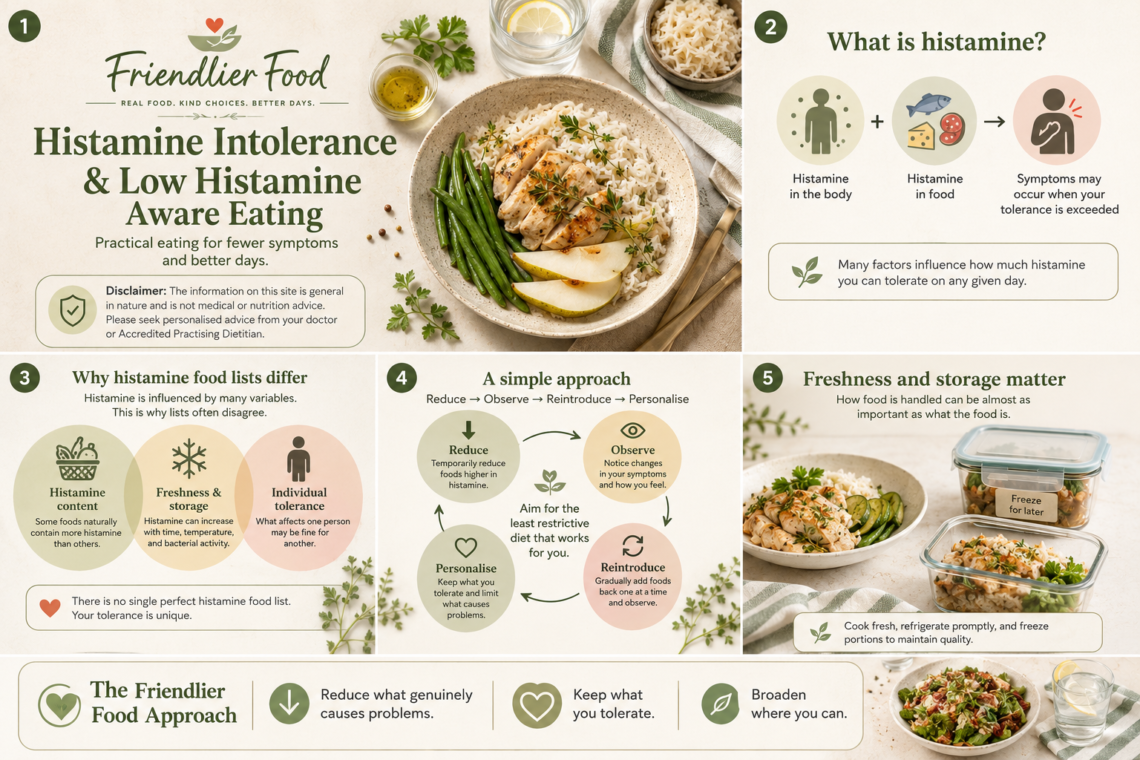
Histamine is a chemical naturally produced by the body. It is involved in many normal functions, including immune responses, digestion and communication within the nervous system.
Histamine can also occur naturally in food.
Histamine intolerance is a proposed condition in which symptoms are thought to occur when the amount of histamine entering the body exceeds the body’s ability to break it down effectively.
It is important to know that histamine intolerance remains an evolving and somewhat controversial area of medicine. There is currently no single reliable test that can diagnose it on its own, and symptoms can overlap with many other conditions. (my.clevelandclinic.org)
Low Histamine Aware Eating
Friendlier Food includes recipes and meal ideas that can be useful for people interested in lower-histamine eating.
Histamine levels in food are not fixed.
They can be affected by:
- fermentation
- ageing
- curing
- bacterial activity
- processing
- freshness
- storage
Foods that have been fermented, aged or cured are among the most consistently recognised sources of dietary histamine. (pmc.ncbi.nlm.nih.gov)
This means that histamine-aware eating is not simply about identifying whether an ingredient is “good” or “bad”.
Freshness, preparation and storage can matter too.
Foods Commonly Higher in Histamine
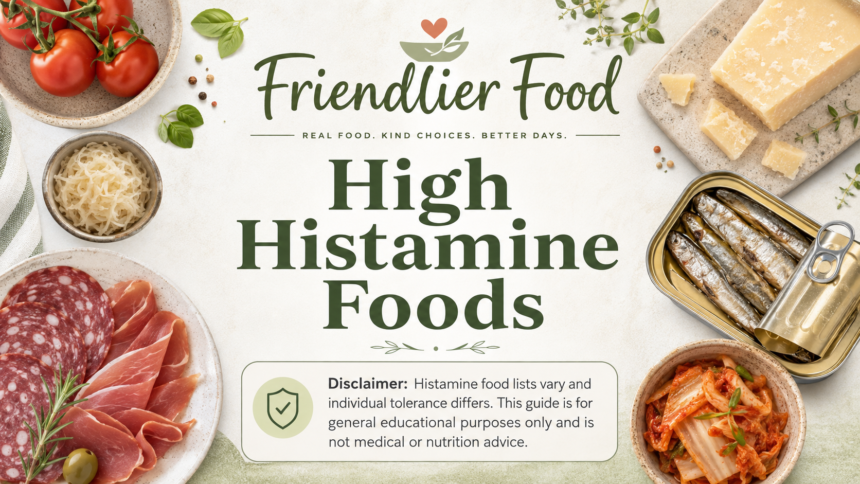
Foods more consistently associated with higher histamine include:
- fermented foods
- aged cheeses
- cured and fermented meats
- smoked or preserved meats
- some canned, smoked and preserved fish
- fermented alcoholic drinks
- foods that have been stored for extended periods under conditions that allow histamine-producing bacteria to grow
Histamine is relatively heat-stable, so once substantial amounts have formed in a food, ordinary cooking does not necessarily remove it. (pmc.ncbi.nlm.nih.gov)
Why Histamine Food Lists Differ
One of the confusing things about following a low histamine diet is that food lists often disagree.
Some lists exclude a very large number of fruits, vegetables, nuts, legumes and other foods.
Others concentrate mainly on foods known to contain significant amounts of histamine.
Research comparing low histamine diets has found considerable variation in which foods are restricted. (pmc.ncbi.nlm.nih.gov)
This is why Friendlier Food avoids presenting one long list as though every food affects every person in the same way.
Individual Tolerance Matters
A food appearing on a histamine list does not automatically mean that everyone needs to avoid it.
Tolerance may vary according to:
- the individual
- portion size
- freshness
- preparation
- what else has been eaten
- medications
- illness
- gastrointestinal health
- overall symptom load
The aim is not necessarily to achieve a completely histamine-free diet.
It is to identify whether reducing dietary histamine meaningfully improves symptoms while keeping eating as varied and nourishing as possible.
A Low Histamine Diet Is Usually Better Viewed as a Trial
For many people, a low histamine diet is most useful as a short-term structured trial, followed by gradual reintroduction.
A simple approach is:
REDUCE → OBSERVE → REINTRODUCE → PERSONALISE
Reduce
Temporarily reduce the foods most consistently associated with high histamine.
Observe
Notice whether symptoms meaningfully improve.
Reintroduce
Gradually bring foods back to determine what is actually tolerated.
Personalise
Keep foods that work for you and limit the foods that repeatedly cause problems.
The goal is generally to reach the least restrictive diet that adequately manages symptoms, rather than remaining on an unnecessarily limited diet indefinitely. Current reviews emphasise both dietary reduction and subsequent reintroduction according to tolerance. (pmc.ncbi.nlm.nih.gov)
Food Is Only One Part of the Picture
Symptoms commonly attributed to histamine intolerance can include:
- headache or migraine
- flushing
- itching or hives
- digestive symptoms
- runny or congested nose
- palpitations
- dizziness
But these symptoms are not specific to histamine intolerance and can occur for many other reasons. (my.clevelandclinic.org)
Symptoms may also be influenced by things such as:
- sleep
- hydration and regular meals
- illness
- alcohol
- medications
- hormones
- gastrointestinal health
- stress and overall physical load
This is why Friendlier Food is not about trying to find a perfectly “safe” diet.
It is about finding a practical middle ground.
Reduce what genuinely causes problems. Keep what you tolerate. Broaden where you can.
Histamine Intolerance Is Not the Same as MCAS
Histamine intolerance and mast cell activation syndrome (MCAS) are not interchangeable.
Histamine intolerance is primarily a proposed problem involving the handling of histamine, particularly dietary histamine.
MCAS is a mast-cell disorder involving episodes of inappropriate mast-cell activation and the release of multiple chemical mediators, of which histamine is only one.
MCAS requires specific diagnostic criteria and should not be diagnosed from symptoms alone. (my.clevelandclinic.org)
Friendlier Food’s Approach
For people who find reducing histamine helpful, Friendlier Food aims to make eating simpler rather than more frightening.
Our approach is to:
- focus first on the more meaningful sources of histamine
- consider freshness and storage
- provide practical meal ideas
- recognise individual tolerance
- avoid unnecessary restriction
- broaden the diet wherever possible
Low histamine aware does not mean eliminating every food that has ever appeared on a histamine list.
The goal is to manage important food triggers without making food more restrictive, complicated or stressful than it needs to be.
If your symptoms are significant, unexplained or your diet is becoming very limited, please seek advice from your doctor or an Accredited Practising Dietitian.
Friendlier Food provides recipes and general educational information only. It is not a substitute for personalised medical or nutrition advice.
I actually think this page could become the main introductory page for your histamine section. Then it could link out to High Histamine Foods, Histamine Intolerance Symptoms, Low Histamine Foods, How Long Should You Follow a Low Histamine Diet?, Histamine and Leftovers, and your low-histamine recipes. That would make the section feel coherent rather than alarmist or overly medical.