Some people notice symptoms after eating foods containing certain natural food chemicals, particularly salicylates, amines and glutamates.
These chemicals occur naturally in many everyday foods and are not harmful for most people. In susceptible individuals, however, they may contribute to symptoms such as headaches, migraine, flushing, digestive symptoms, nasal symptoms or skin reactions.
Food chemical intolerance is different from a food allergy and is often dose-related. This means that someone may tolerate a small amount of a food or food chemical but develop symptoms when their individual tolerance is exceeded.
What Are Salicylates?
Salicylates are naturally occurring chemicals made by plants.
They are found in varying amounts in many:
- fruits
- vegetables
- herbs
- spices
- nuts
- teas
- flavourings
They are chemically related to salicylic acid, which is associated with aspirin.
People who are sensitive to salicylates may report symptoms such as:
- headache or migraine
- nasal congestion
- skin symptoms
- digestive symptoms
The amount tolerated varies greatly from person to person.
What Are Amines?
Amines are naturally occurring compounds that can increase as foods ripen, age, ferment or are stored.
Examples include:
- histamine
- tyramine
- phenylethylamine
Amines may be found in higher amounts in some:
- aged cheeses
- cured meats
- fermented foods
- chocolate
- ripe or aged foods
- processed foods
Some people who are sensitive to amines report symptoms such as:
- headache or migraine
- flushing
- nasal symptoms
- digestive upset
Amines and histamine are related but not identical
Histamine is one type of biogenic amine.
This means a low-amine food intolerance diet and a low-histamine diet can overlap, but they are not the same thing.
A broader food chemical intolerance approach may consider several naturally occurring amines rather than histamine alone.
What Is Glutamate?
Glutamate is an amino acid that occurs naturally in many foods.
It is also the active component of monosodium glutamate — MSG.
Naturally occurring glutamate can be found in foods such as:
- tomatoes
- mushrooms
- mature cheeses
- soy sauces
- yeast extracts
- meat extracts
- strongly flavoured stocks and sauces
Some people report symptoms after larger amounts of naturally occurring glutamate or added MSG.
Again, this does not mean glutamate is harmful to most people.
It is about individual tolerance.
Food Intolerance Can Be Cumulative
Food chemical intolerance may not always behave like a simple:
eat one food → get one symptom
relationship.
A person may tolerate individual foods reasonably well but experience symptoms after several higher-chemical foods are eaten close together.
This is sometimes described as exceeding an individual’s tolerance threshold.
For example:
salicylates + amines + glutamates + additives
may contribute to the overall dietary load for someone who is susceptible.
This helps explain why identifying one particular “problem food” can sometimes be difficult.
The RPAH Food Chemical Elimination Approach
In Australia, the Royal Prince Alfred Hospital Allergy Unit elimination diet is one clinical approach used to investigate suspected food chemical intolerance.
It considers naturally occurring food chemicals including:
- salicylates
- amines
- glutamates
as well as certain food additives.
The strict elimination stage is primarily an investigative tool.
Its purpose is to establish whether reducing food chemicals makes a meaningful difference to symptoms and, where appropriate, to use challenges and reintroduction to identify individual tolerance.
The goal is not necessarily to remain on the strictest diet indefinitely.
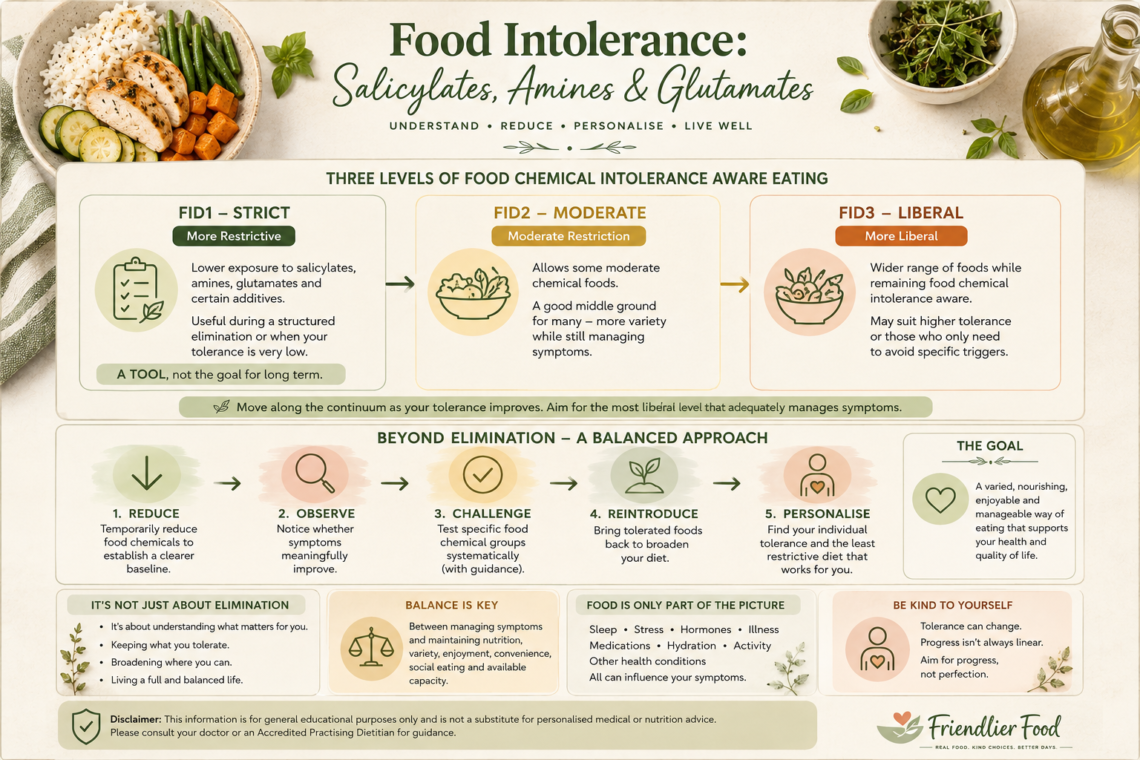
Friendlier Food Diet Levels
To make recipes easier to navigate, Friendlier Food classifies food chemical intolerance recipes using three practical levels.
FID1 — Strict Food Intolerance Diet
FID1 represents the most restrictive level.
Recipes in this category are designed around foods generally suitable for a stricter elimination-style approach, with lower exposure to the food chemicals being considered.
This level may be most relevant during a structured elimination period or for someone who knows they currently have a very low tolerance.
FID1 is not automatically the goal for long-term eating.
A strict diet can be useful as an investigative tool, but remaining unnecessarily restricted can reduce dietary variety and make everyday eating more difficult.
FID2 — Moderate Food Intolerance Diet
FID2 allows a broader range of foods and moderate amounts of food chemicals.
This may suit someone who:
- has completed an elimination and challenge process
- knows they tolerate some moderate-chemical foods
- does not need the strictest restriction
- wants greater dietary variety while still managing symptoms
For many people, this kind of middle ground may be more practical and sustainable than trying to eat at FID1 all the time.
FID3 — Liberal Food Intolerance Diet
FID3 is the most liberal Friendlier Food category.
It includes a wider range of foods while still being mindful of ingredients that may matter for people with food chemical intolerance.
This level may suit someone who:
- has a higher tolerance
- has successfully reintroduced many foods
- only needs to limit particular triggers
- wants to maintain awareness without following a highly restrictive diet
The aim is to eat at the most liberal level that adequately manages symptoms.
Think of FID1, FID2 and FID3 as a Continuum
Rather than:
SAFE → UNSAFE
Friendlier Food uses:
FID1 → FID2 → FID3
as a practical way of recognising that food tolerance exists on a spectrum.
Someone may move between levels over time.
For example:
FID1
More restrictive
↓
FID2
Moderate
↓
FID3
More liberal
The direction of travel, where possible, is generally toward greater variety and flexibility, not greater restriction.
Elimination Is Only the Beginning
An elimination diet can help answer:
“Does food chemical reduction make a meaningful difference?”
But that is only the first part of the process.
A more complete approach is:
REDUCE → OBSERVE → CHALLENGE → REINTRODUCE → PERSONALISE
Reduce
Temporarily reduce suspected food chemicals enough to establish a clearer baseline.
Observe
Notice whether symptoms actually improve.
Challenge
Where appropriate, individual food chemical groups can be challenged systematically.
Reintroduce
Bring tolerated foods back into the diet.
Personalise
Work out the level and combination of foods that suits you.
This is the point where a person may move from FID1 toward FID2 or FID3.
Beyond Elimination
For Friendlier Food, food intolerance management is not only about what you remove.
It is also about what happens after elimination.
That can include:
Broadening
Reintroducing tolerated foods and increasing dietary variety.
Balancing
Considering nutrition, enjoyment, family meals, convenience and quality of life alongside symptom management.
Adapting
Recognising that tolerance may not be exactly the same every day or at every stage of life.
Simplifying
Using familiar meals, reliable ingredients, prepared components and flexible recipes so that food management does not consume excessive time and energy.
Living
Being able to eat with family, travel, celebrate, enjoy food and participate in everyday life wherever possible.
The diet needs to serve the person.
The person should not have to spend their entire life serving the diet.
Balance Matters
A useful food intolerance diet sits somewhere between two extremes:
Ignoring reproducible food triggers
and
restricting more and more foods in an attempt to eliminate every possible symptom.
Neither extreme is particularly helpful.
A more balanced question is:
“What level of dietary restriction gives me worthwhile symptom improvement without creating unnecessary nutritional, emotional or practical burden?”
For one person, that may currently be FID1.
For another, it may be FID2.
For another, it may mean eating largely at FID3 while avoiding only a few specific triggers.
The Least Restrictive Diet That Works
One of the most useful long-term goals is:
the least restrictive diet that adequately manages symptoms.
This means:
keep what you tolerate
rather than
avoid everything that appears on a food intolerance list.
If a food has been successfully reintroduced, there is generally little value in continuing to avoid it simply because someone else reacts to it.
Food Is Only One Part of the Picture
Symptoms such as migraine, digestive upset, flushing or nasal congestion may also change with:
- sleep
- illness
- hormones
- medications
- hydration
- regular meals
- stress
- physical load
- environmental exposures
- other health conditions
This is important because a symptom flare after a meal does not automatically prove that food was the cause.
Sometimes food contributes.
Sometimes several things contribute.
Sometimes food has very little to do with it.
Avoid Turning Food Management Into Another Source of Load
For people managing chronic symptoms, food preparation and monitoring can itself take substantial capacity.
Very strict eating may mean:
- more shopping
- more cooking
- less convenience
- difficulty eating outside the home
- difficulty sharing meals
- more decision-making
- more attention directed toward symptoms and food
These costs matter too.
A dietary strategy is most useful when the benefit outweighs the burden.
A More Balanced Friendlier Food Model
Think of food intolerance management as having two sides:
Symptom Management
Reduce the food chemicals that genuinely contribute to symptoms.
Quality of Life
Protect:
- nutritional variety
- enjoyment
- convenience
- social eating
- family meals
- flexibility
- available capacity
The best long-term diet is usually somewhere between these two needs.
The Friendlier Food Approach
Friendlier Food aims to help people move beyond simply asking:
“What can’t I eat?”
toward:
“What can I eat, what do I tolerate, and how can I make eating easier?”
Our approach is:
REDUCE what genuinely causes problems.
KEEP what you tolerate.
BROADEN where you can.
And use FID1, FID2 and FID3 as practical guides rather than permanent labels.
In simple terms:
FID1 — Strict
Useful when greater restriction is genuinely needed.
FID2 — Moderate
A broader middle ground.
FID3 — Liberal
The widest variety while remaining food-intolerance aware.
Where possible:
ELIMINATION → UNDERSTANDING → REINTRODUCTION → BALANCE
The aim is not a perfect diet.
It is a varied, nourishing, enjoyable and manageable way of eating that works for you.
If you are undertaking a significant elimination diet, particularly one involving several food groups, consider working with your doctor or an Accredited Practising Dietitian experienced in food intolerance.
Friendlier Food provides recipes and general educational information. It is not a substitute for personalised medical or nutrition advice.
I think the FID1 → FID2 → FID3 continuum should become one of the key visuals for this page. I’d put “Beyond Elimination” underneath it, showing the direction as strict elimination → identify tolerance → broaden → balance, rather than presenting the three levels as three fixed diets. That would make your classification system much easier for readers to understand and would reinforce that FID1 is a tool, not necessarily the destination.