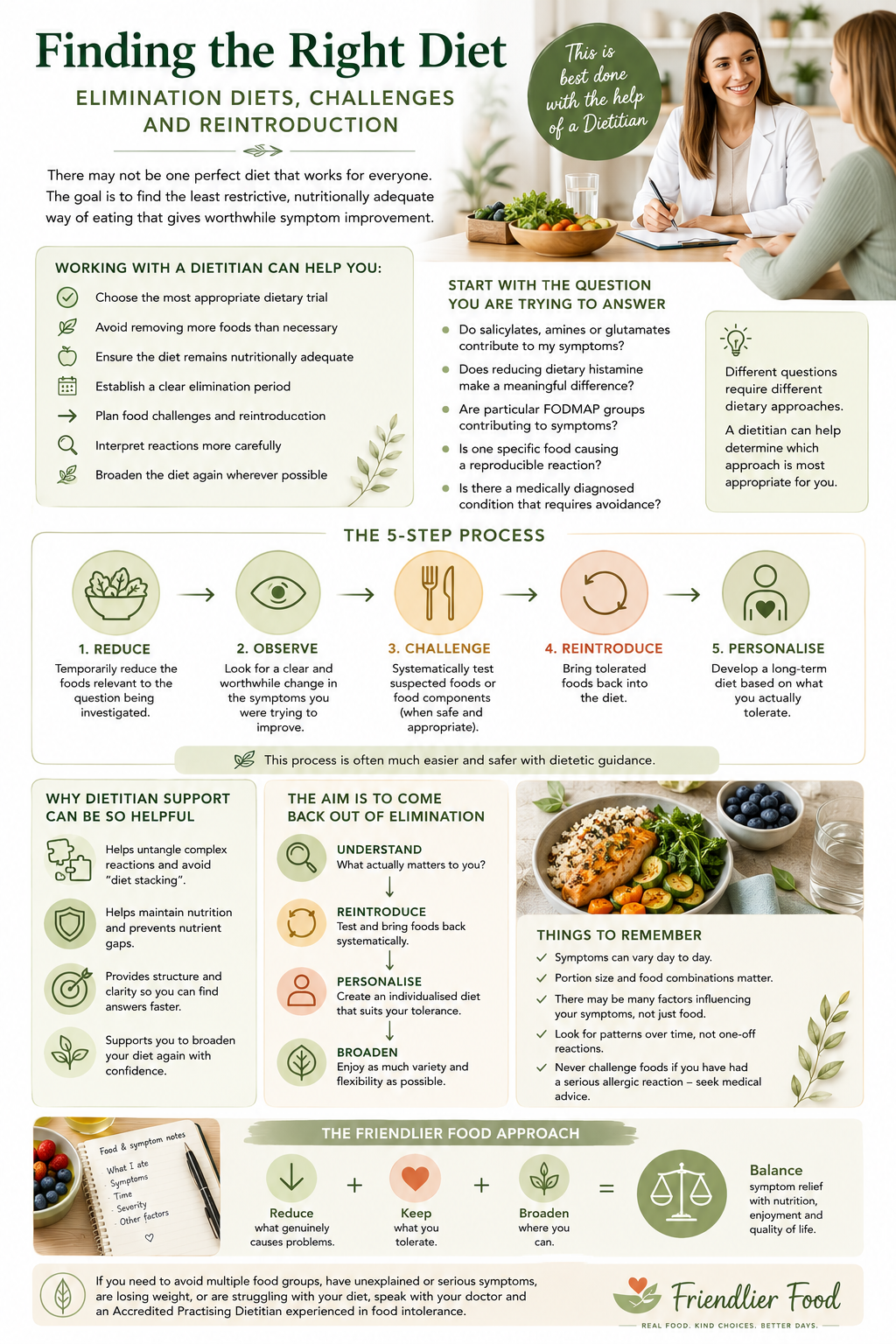
When food seems to affect symptoms, it is tempting to look for the right diet.
But there may not be one perfect diet that works for everyone.
Low histamine, low salicylate, low amine, low glutamate, low FODMAP, gluten free and other elimination approaches all address different possible problems. Symptoms can overlap, and combining several restrictive diets can quickly make eating complicated.
Elimination diets are best undertaken with the help of an Accredited Practising Dietitian, particularly if the diet is very restrictive, involves several food groups, or is being used to investigate ongoing symptoms.
A dietitian can help you:
- choose the most appropriate dietary trial
- avoid removing more foods than necessary
- make sure the diet remains nutritionally adequate
- establish a clear elimination period
- plan food challenges and reintroduction
- interpret reactions more carefully
- broaden the diet again wherever possible
The goal is not simply to find a list of foods to avoid.
It is to find the least restrictive, nutritionally adequate way of eating that gives worthwhile symptom improvement.
An Elimination Diet Is a Structured Investigation
An elimination diet is most useful when there is a clear question being tested.
For example:
Do salicylates, amines or glutamates contribute to my symptoms?
Does reducing dietary histamine make a meaningful difference?
Are particular FODMAP groups contributing to gastrointestinal symptoms?
A dietitian can help determine which approach is most appropriate rather than trying several diets at once.
A useful process is:
REDUCE → OBSERVE → CHALLENGE → REINTRODUCE → PERSONALISE
Reduce
Temporarily reduce the foods relevant to the question being investigated.
Observe
Look for a clear and worthwhile change in the symptoms you were trying to improve.
Challenge
Systematically test suspected foods or food components when it is medically appropriate to do so.
Reintroduce
Bring tolerated foods back into the diet.
Personalise
Develop a long-term diet based on what you actually tolerate.
This process is often much easier and safer with dietetic guidance.
Why Dietitian Support Can Be So Helpful
When symptoms are complicated, it can be difficult to know whether a reaction came from:
- histamine
- salicylates
- amines
- glutamates
- FODMAPs
- another food component
- portion size
- food preparation
- another health factor entirely
A dietitian can help separate these possibilities and reduce the risk of diet stacking — following several restrictive diets simultaneously.
They can also help make sure important nutrients are replaced when foods are removed.
This becomes particularly important if you are:
- already following another restricted diet
- losing weight
- struggling to eat enough
- avoiding several major food groups
- managing gastrointestinal disease
- feeding a child
- pregnant or breastfeeding
- experiencing significant anxiety around food
- unsure how to reintroduce foods
The Aim Is to Come Back Out of Elimination
A good elimination diet should have an exit plan.
Restriction is usually the investigative stage.
The longer-term work is:
UNDERSTAND → REINTRODUCE → PERSONALISE → BROADEN
A dietitian can be particularly helpful during this stage because reintroduction may feel more difficult than elimination.
The aim is not to stay on the strictest diet you can tolerate.
It is to determine:
What genuinely needs to stay out?
What can come back?
What can I tolerate in smaller amounts?
How broad can my diet become while still managing symptoms?
The Friendlier Food Approach
Friendlier Food supports elimination diets as tools for understanding food tolerance, rather than permanent destinations.
Where possible:
Reduce what genuinely causes problems.
Keep what you tolerate.
Broaden where you can.
And when a significant elimination diet is needed:
work with an Accredited Practising Dietitian to help make the process safer, clearer and less restrictive than it needs to be.
Friendlier Food provides recipes and general educational information. It is not a substitute for personalised medical or nutrition advice.