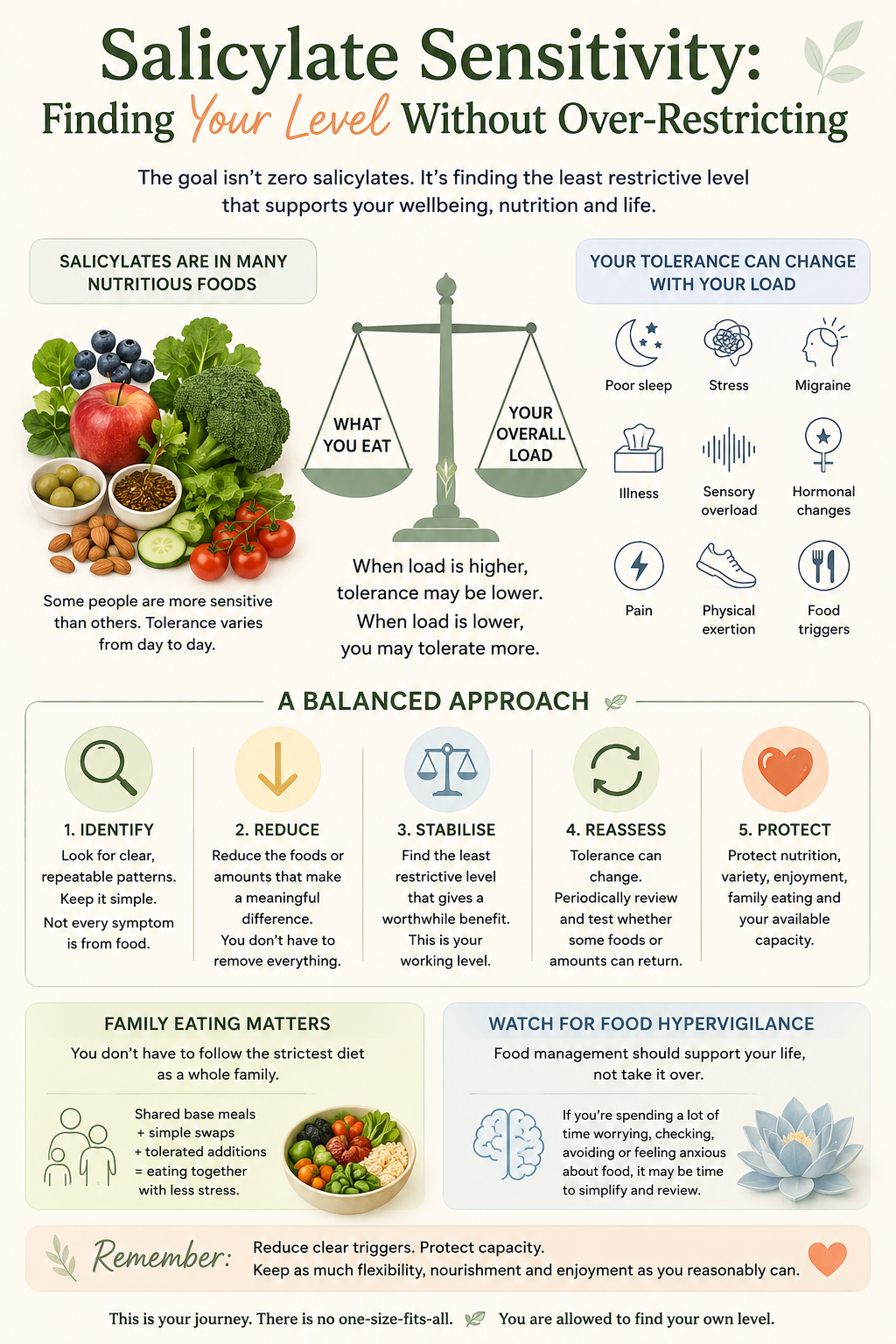
Medical note: This page is for general education and meal-planning support and is not a substitute for personalised medical or nutrition advice. Restrictive diets can affect nutritional adequacy. If you are making substantial dietary changes, experiencing significant reactions or have a very limited diet, discuss this with your doctor and an accredited practising dietitian.
Salicylates are naturally occurring chemicals found in many plant foods, including fruits, vegetables, herbs and spices. Some people report symptoms when their overall salicylate intake becomes too high for their individual tolerance.
For someone who appears sensitive, reducing salicylates can sometimes be useful.
But the aim does not necessarily need to be:
avoid every salicylate-containing food forever.
A more sustainable goal is:
Find the least restrictive level that gives a worthwhile benefit while protecting nutrition, variety, family life and quality of life.
Salicylate Sensitivity Is Not the Same for Everyone
Salicylates occur naturally across a wide range of foods.
NSW Health includes a low-salicylate diet among its clinical diet specifications for people with recognised salicylate intolerance.
However, sensitivity and tolerance can vary considerably between people.
Someone may tolerate:
- small amounts but not large amounts;
- some higher-salicylate foods but not others;
- a mixed diet most of the time but become more reactive during a flare; or
- considerably more food variety than an extensive online “avoid” list might suggest.
This is one reason individual experience matters more than trying to create a perfectly salicylate-free diet.
Think About Your Overall Load
Food is only one source of load.
For someone with a Sensitive Neurotype, symptoms may also be influenced by things such as:
poor sleep + migraine activity + sensory overload + illness + stress + pain + hormonal changes + physical exertion + food triggers
When several loads occur together, tolerance may feel lower.
This can make food reactions difficult to interpret.
A food eaten during a particularly difficult week may appear to cause a major reaction, while the same amount may be tolerated much better at another time.
This does not mean that symptoms are imagined.
It means that it can be useful to look at the whole capacity-and-load picture, rather than assuming every symptom comes from food.
Avoid the Ever-Growing Food List
One of the risks of managing food sensitivity is that the list of restricted foods can gradually become larger.
A difficult reaction occurs.
Another food is removed.
Then another.
Eventually eating can involve enormous amounts of:
checking → remembering → analysing → planning → cooking separately → worrying → avoiding
For a person already living with limited capacity, food management itself can become a significant source of cognitive and emotional load.
That is worth considering alongside any benefit from the restriction.
Look for Clear, Repeatable Benefits
When deciding whether a restriction remains useful, it can help to ask:
- Does reducing this food clearly improve my symptoms?
- Has the effect happened more than once?
- Does the amount seem to matter?
- Is complete avoidance necessary, or is reducing the amount enough?
- Am I restricting this because of my own experience or because it appeared on a food list?
- What is the nutritional and practical cost of avoiding it?
The goal is not to prove that every reaction is caused by salicylates.
It is to identify patterns that are useful enough to act on.
Avoidance and Exposure: Finding the Middle Ground
There are two extremes that may be unhelpful.
Too little avoidance
Repeatedly consuming something that clearly produces significant symptoms may create unnecessary suffering and load.
Too much avoidance
Removing increasing numbers of foods “just in case” can reduce variety, make eating difficult and increase anxiety and vigilance around food.
The middle ground may look more like:
identify → reduce → stabilise → carefully reassess
Rather than:
react → eliminate permanently
For some people, a structured elimination and challenge process under appropriate professional guidance may help clarify whether particular food chemicals are genuinely contributing to symptoms.
Protect Nutrition and Variety
Salicylates occur in many nutritious plant foods, so broad restriction can remove significant dietary variety. NSW Health’s low-salicylate hospital specification excludes substantial sources across fruits, vegetables, herbs, nuts and spices.
That makes nutritional balance particularly important.
Where possible, aim for the:
broadest nutritious diet that you can comfortably tolerate.
If your diet has become very restricted, an accredited practising dietitian, particularly one experienced with food intolerance, can help assess nutritional adequacy and whether all current restrictions remain necessary.
Family Eating Matters Too
Food intolerance affects more than the individual eating the food.
It can affect:
- shopping;
- cooking;
- school lunches;
- restaurants;
- celebrations;
- holidays;
- eating with friends;
- family meals; and
- the amount of work required to feed everyone.
Sometimes the most sustainable solution is not making the entire household follow the strictest diet.
Families may instead use:
shared base meals + simple swaps + tolerated additions + individual extras
This can preserve eating together without making every meal complicated.
Watch for Food Hypervigilance
When symptoms are unpredictable, it is understandable to pay close attention to food.
But constant monitoring can eventually become exhausting.
Signs that food management may need reviewing include:
- spending large amounts of time checking ingredients;
- becoming frightened of trying foods;
- continuing to remove foods without clear evidence of benefit;
- feeling that almost everything is potentially unsafe;
- avoiding social situations because of food;
- preparing multiple complicated meals every day; or
- thinking about food reactions for much of the day.
At that point the question becomes not only:
“What might trigger symptoms?”
but also:
“Is the way I am managing food helping my overall wellbeing?”
Tolerance Can Be a Range
You do not necessarily need to divide food into:
SAFE or UNSAFE.
For some people a more useful framework is:
Usually tolerated
Tolerated in moderate amounts
Sometimes troublesome
Clear personal trigger
Not sure yet
This leaves room for individual tolerance and new information.
When Symptoms Are Changing
If reactions suddenly become stronger, more frequent or different, avoid automatically assuming that salicylates are responsible.
New or worsening symptoms may warrant medical review, particularly when there are symptoms such as significant swelling, breathing difficulty, fainting, gastrointestinal bleeding, unexplained weight loss or other concerning changes.
Food restriction should not replace appropriate medical investigation.
A Simple Approach
If salicylates appear relevant, you do not need to solve everything at once.
Think:
REDUCE
Reduce the exposures that appear to make a meaningful difference.
REVIEW
Periodically ask whether each restriction is still useful.
REINTRODUCE
Where appropriate and safe, explore whether some foods or amounts can return.
PROTECT
Protect nutrition, variety, enjoyment, family eating and your available capacity.
The aim is not a perfect diet.
It is a workable diet that helps more than it costs.
The Bigger Picture
Salicylate sensitivity can be one piece of a much larger picture.
Food chemicals such as salicylates, amines and glutamates, along with additives, meal timing, migraine susceptibility, gut symptoms, sleep and overall nervous-system load, may all be relevant for different people. NSW Health, for example, maintains separate clinical diet specifications addressing salicylates, amines and glutamate.
You do not need to manage every possible factor.
Start with what appears most important.
Reduce clear triggers. Protect capacity. Keep as much flexibility, nourishment and enjoyment as you reasonably can.