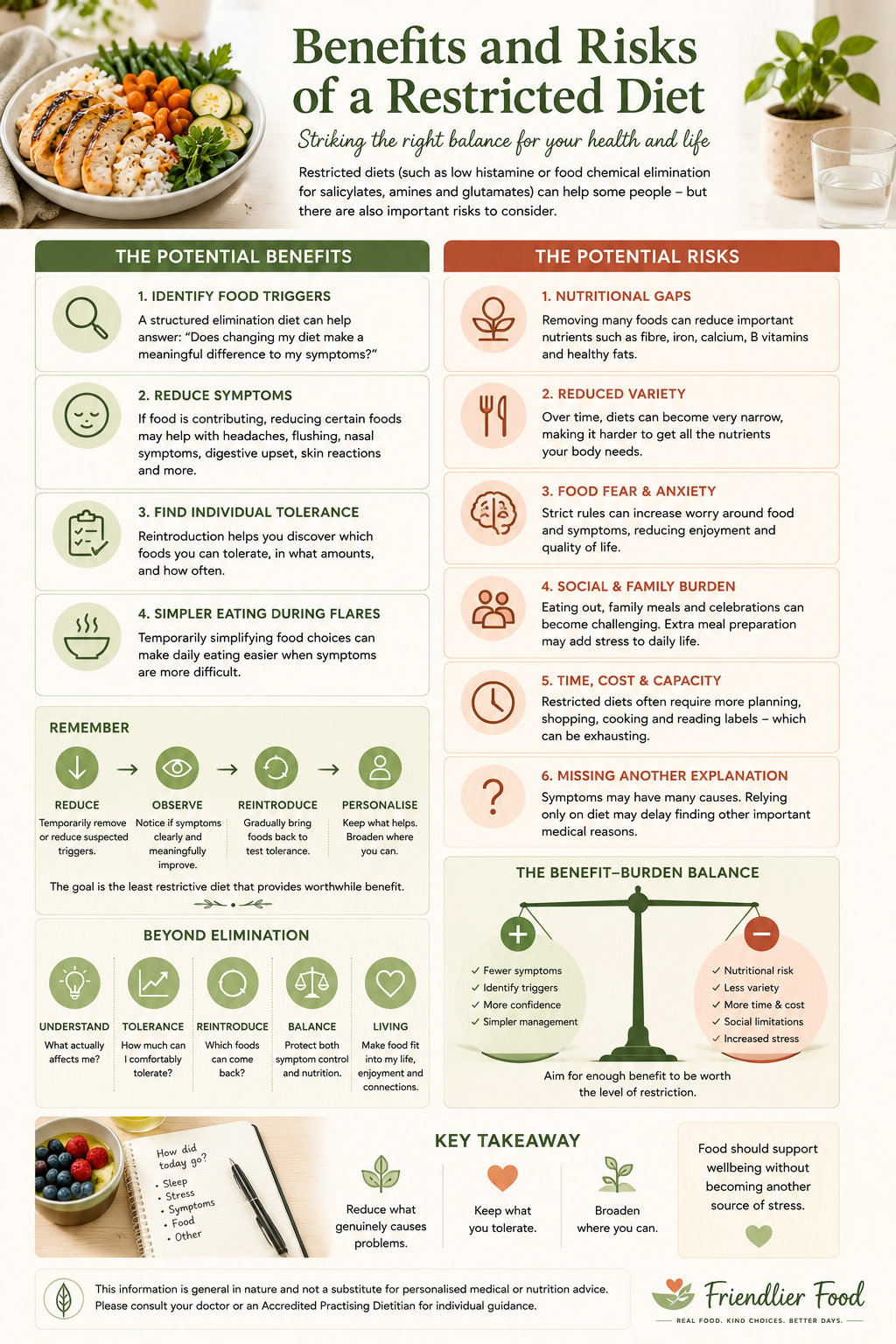
Benefits and Risks of a Restricted Diet
Restricted diets can sometimes be useful when food appears to contribute to symptoms.
Examples include:
- a low histamine diet
- a food chemical elimination diet reducing salicylates, amines and glutamates
- diets that temporarily remove particular foods to investigate symptoms
For some people, reducing particular foods can make a meaningful difference. But restriction can also have costs, especially when diets become very limited or continue for longer than necessary.
The goal is not simply to remove as many foods as possible.
It is to find the least restrictive diet that provides worthwhile benefit.
Potential Benefits
1. Helping Identify Whether Food Is Actually Involved
A carefully structured elimination diet can help answer:
“Does changing my diet make a meaningful difference to my symptoms?”
This can be particularly useful when symptoms are variable and it is difficult to identify triggers from individual meals.
ASCIA notes that food intolerance reactions can involve naturally occurring chemicals such as salicylates, amines and glutamate, and that elimination and challenge may be used to investigate suspected intolerance. (Allergy Australia)
For suspected histamine intolerance, response to a lower-histamine diet followed by reintroduction is also commonly used because there is currently no single validated diagnostic biomarker. (PubMed Central (PMC))
2. Reducing Symptoms
If a particular food or food chemical genuinely contributes to symptoms, reducing exposure may help.
Depending on the individual and the condition being investigated, improvements may include reductions in symptoms such as:
- headache or migraine
- flushing
- nasal symptoms
- digestive discomfort
- diarrhoea
- itching or skin symptoms
The important word is if.
Improvement during a restricted diet provides useful information, but symptoms should still be considered alongside other possible causes.
3. Finding Individual Tolerance
Restriction can provide a temporary baseline from which foods are gradually challenged or reintroduced.
This can help identify:
- foods that clearly cause problems
- foods tolerated in small amounts
- foods tolerated in moderate amounts
- foods that were unnecessarily excluded
This is one of the most valuable reasons to reintroduce foods rather than staying permanently on an elimination diet.
4. Creating Simpler Meals During a Flare
Sometimes temporarily simplifying food choices can make eating easier when symptoms are particularly difficult.
Familiar meals and fewer variables may reduce:
- decision-making
- uncertainty about ingredients
- complicated food preparation
- difficulty recognising patterns
This can be useful for a period of time, provided the diet remains nutritionally adequate.
The Risks of Restriction
The fact that a restricted diet can be useful does not mean that more restriction is always better.
1. Nutritional Gaps
Removing many foods can reduce important sources of:
- protein
- fibre
- calcium
- iron
- B vitamins
- vitamin C
- folate
- healthy fats
- other vitamins and minerals
The risk becomes greater when several food groups are removed at the same time or suitable replacements are not included.
Reviews of elimination diets consistently emphasise the need to maintain nutritional adequacy and dietary diversity. (PubMed Central (PMC))
This is particularly relevant to food chemical diets because salicylates occur naturally in many fruits and vegetables, while low-histamine diets may also remove fermented foods, some protein foods and other commonly eaten foods.
2. Reduced Dietary Variety
A food can disappear from the diet simply because it appears on a restriction list, even when the person actually tolerates it.
Over time, a diet may become progressively narrower:
one food removed → another suspected → another removed → very few foods remaining
This can make it increasingly difficult to achieve a balanced diet.
Low-histamine diets are a good example of why caution is needed: published food lists vary substantially in the foods they recommend excluding. (PubMed Central (PMC))
A food appearing on one list does not necessarily mean that everyone with suspected histamine intolerance needs to avoid it.
3. Food Can Become a Source of Fear
Restriction can sometimes shift from:
“This food seems to aggravate my symptoms.”
to:
“This food is dangerous.”
That distinction matters.
Foods containing salicylates, amines, glutamates or histamine are not inherently unhealthy or toxic.
For someone with sensitivity, the issue is generally tolerance and amount, not whether the food is universally good or bad.
Excessive restriction and anxiety around food can also affect quality of life. Elimination-diet research has recognised both nutritional and psychosocial burdens when multiple foods are excluded. (PubMed Central (PMC))
4. Hypervigilance Around Symptoms
The more closely we monitor every meal and bodily sensation, the easier it can become to associate normal symptom fluctuations with food.
This does not mean reactions are imagined.
It means symptoms such as migraine, digestive upset, flushing, fatigue and nasal congestion can have multiple contributing factors.
These may include:
- food
- illness
- sleep
- hormones
- medications
- stress
- hydration
- environmental exposures
- overall physical load
Food diaries can be useful, but they work best when they help identify reproducible patterns rather than encouraging constant surveillance.
5. Social and Family Burden
Very restrictive diets can affect more than nutrition.
They may make it harder to:
- eat with family
- dine out
- travel
- attend celebrations
- use convenient foods
- share meals
- eat spontaneously
Separate meals and extensive food preparation can also place additional demands on the person following the diet and on their family.
These are genuine costs and should be weighed against the benefit the diet provides.
6. Time, Money and Capacity
Restricted diets often require:
- more label reading
- specialty products
- additional shopping
- meal planning
- cooking from scratch
- food preparation
- freezing and storage
- carrying food when away from home
For someone already living with chronic symptoms, the diet itself can consume a significant amount of available capacity.
A dietary approach should ideally reduce overall burden rather than become another full-time treatment.
7. Missing Another Explanation
One of the biggest risks of assuming symptoms are food-related is that another medical explanation may be overlooked.
Symptoms attributed to histamine or food chemicals can overlap with many other conditions.
For example:
- migraine
- food allergy
- coeliac disease
- IBS
- reflux
- medication effects
- allergic rhinitis
- mast-cell disorders
- hormonal changes
Diet should therefore be only one part of assessment when symptoms are significant or unexplained.
Histamine Diets: A Particular Challenge
Low-histamine eating can be useful for some people, but there is no universally agreed low-histamine food list.
Research reviews have found considerable disagreement between diets about which foods should be excluded. (PubMed Central (PMC))
Some foods genuinely contain higher amounts of histamine, particularly foods that are:
FERMENTED → AGED → CURED → PRESERVED → POORLY STORED
But other foods are excluded from some lists because they are proposed to be “histamine liberators” or interfere with histamine metabolism, and the evidence for these categories is much less consistent.
This is why an increasingly long exclusion list is not necessarily a better low-histamine diet.
Food Chemical Elimination Diets
A food chemical elimination approach may temporarily reduce:
- salicylates
- amines
- glutamates
- certain additives
This can help determine whether these substances contribute to symptoms in an individual.
However, because these natural chemicals occur across a wide variety of foods, a strict elimination diet can become quite restrictive.
The useful long-term information is not:
“How strictly can I remain on the elimination diet?”
but:
“What is my actual tolerance?”
That is where challenge and reintroduction become important.
Elimination Should Have an Exit Plan
A useful restricted diet usually has several stages:
REDUCE → OBSERVE → CHALLENGE/REINTRODUCE → PERSONALISE
Reduce
Temporarily remove or reduce the suspected triggers enough to create a useful baseline.
Observe
Ask whether symptoms have clearly and meaningfully improved.
Challenge or Reintroduce
Gradually bring foods or food chemical groups back.
Personalise
Keep restrictions that provide genuine benefit and remove restrictions that do not.
For suspected histamine intolerance, current reviews similarly emphasise dietary reduction followed by reintroduction according to individual tolerance. (PubMed Central (PMC))
The Benefit–Burden Balance
A useful way to evaluate any restricted diet is to look at both sides.
Possible benefits
- fewer symptoms
- clearer identification of triggers
- greater confidence about tolerated foods
- simpler symptom management
Possible burdens
- reduced nutrition
- reduced variety
- food anxiety
- increased preparation
- increased cost
- social restriction
- family burden
- treatment fatigue
The important question is:
Is the benefit large enough to justify the level of restriction?
If removing one or two foods makes a substantial difference, the trade-off may be worthwhile.
If avoiding 40 foods produces only a tiny improvement, it may be worth reconsidering the strategy.
Beyond Elimination
Long-term food intolerance management does not have to remain centred on restriction.
It can gradually become about:
UNDERSTANDING
What actually affects me?
TOLERANCE
How much can I comfortably eat?
REINTRODUCTION
Which foods can come back?
BALANCE
How do I protect both symptom control and nutrition?
LIVING
How can food fit into family life, convenience, enjoyment and social connection?
That is a very different goal from trying to achieve a perfectly controlled diet.
The Friendlier Food Approach
At Friendlier Food, restricted diets are viewed as tools rather than destinations.
Sometimes a period of greater restriction is useful.
But where possible, the direction should be toward:
less unnecessary restriction + greater understanding + more variety + better quality of life
A simple principle is:
REDUCE what genuinely causes problems.
KEEP what you tolerate.
BROADEN where you can.
And remember that the best diet is not necessarily the strictest diet.
It is the least restrictive, nutritionally adequate and manageable way of eating that provides worthwhile symptom benefit.
If you need to avoid multiple foods, have unexplained symptoms, are losing weight, are struggling to meet nutritional needs, or find that food rules are becoming increasingly difficult to manage, speak with your doctor and an Accredited Practising Dietitian experienced in food intolerance.
Friendlier Food provides recipes and general educational information. It is not a substitute for personalised medical or nutrition advice.